Showing posts with label Romance. Show all posts

Monday, 3 October 2016

Love At First Bite (1979)


October is here! This is the only time of year you can talk non-stop about werewolves and candy corn and Ray Bradbury and nobody looks at you sideways, and I intend to take full advantage of it!

We’re starting with an underrated gem in which George Hamilton plays Disco Dracula and Susan Saint James is his pot smoking lady love.

The 70’s were a culturally awesome time for horror, much in the way the 80’s would nail the fantasy genre. In 1972, American International Pictures made a movie about an African prince who visits Transylvania, gets turned into a vampire and sealed in a coffin until awakening in modern day Los Angeles. In 1974, the late, great, forever in our hearts Gene Wilder teamed up with Mel Brooks to astound one and all (including their investors) when they made a hit comedy out of a Christmastime release of a black and white spoof of Universal’s Son of Frankenstein. Sitting happily between Blacula and Young Frankenstein is 1979’s Love at First Bite.

I wouldn’t go so far to say it’s as good as either film, but it is good.

The story begins when the Romanian government commanders Dracula’s castle as a gymnastics training center for Nadia Comaneci. He has two days to pack up his coffin and his cobwebs and get out before they put in the balance beams.

It’s not the worst thing that could’ve happened to this version of Dracula. A sort of dusty gothic ennui has taken him over, and he’s been bored. Not to mention terribly lonely. One of his few enjoyments comes from American magazines that feature his latest obsession: fashion model Cindy Sondheim.

Dracula is convinced that Cindy is the reincarnation of his great love, and had been Mina Harker in a previous life. In order to turn her fully into a vampire so she can share his monstrous eternity with him, he has to bite her on the neck three separate times. Getting kicked out of the castle spurs him into action. He – along with his semi-immortal, bug eating sidekick Renfield (played delightfully to the hilt by Arte Johnson) – are going to hit up New York high society and find Cindy.


A lot of the comedy thereafter is about an out-of-touch European relic trying to blend into the nightlife. But even more of it is about how the expectations of movie audiences changed between 1931 and 1979, in the same way Young Frankenstein had explored genre shifts, but a little less elegantly. A running gag revolves around whether or not Dracula has seen Roots, and there are constant sly winks that hint the Hollywood version of 70’s New York is authentic as the Hollywood versions of 1930’s London or Transylvania in any time period.

There are terrific cameos from The Jeffersons; Sherman Hemsley turns up as a corrupt preacher whose funeral service is interrupted, and Isobel Sanford is an unsympathetic New York judge. Dick Shawn plays a haggard police detective who doesn’t particularly want to believe in vampires, but has to face facts, and Susan Tolsky gives a great, brief performance as Cindy’s agent. There’s more than a little Sue Mengers in it.

George Hamilton is a charming, clever Dracula, weighing the scales just right to evoke everyone’s memories of Bela Lugosi, but taking into account the necessary angles to make him seem both human enough to carry the story and inhuman enough to be funny.

If you’re of the camp that gets extremely annoyed by Susan Saint James, I’d still suggest giving this one a try. I know several people who can’t stand her, and a direct quote from one of them was: “I didn’t want to punch Susan Saint James in the face in that Dracula thing you lent me.” If you usually like her, you might enjoy seeing her with a very different look, as she sports fluffy blonde supermodel hair and ultra-glam nightwear throughout.

The absolute highlight of Love at First Bite, for me at least, is Richard Benjamin as Dr. Jeffrey Rosenberg. Jeffrey comes from the Van Helsing family, but changed his name for professional purposes. He’s a psychiatrist to the rich and famous, and very happily strings Cindy along in a commitment-free affair – until Dracula appears and he almost instinctively transforms into an obsessive vampire hunter. Except he can't quite remember how it's supposed to work. Vampires are the silver bullet ones, right?


It’s worth adding, though, that a serious familiarity with Universal’s 1931 Dracula helps the humour a lot. So if you’ve never seen the movie that started the sexy vampire craze to begin with, start there. (Interesting tidbit: makeup artist William Tuttle worked on both the 1931 Dracula and Love At First Bite!) Otherwise, consider adding this one to your lighthearted Halloween roster.

Saturday, 9 July 2016

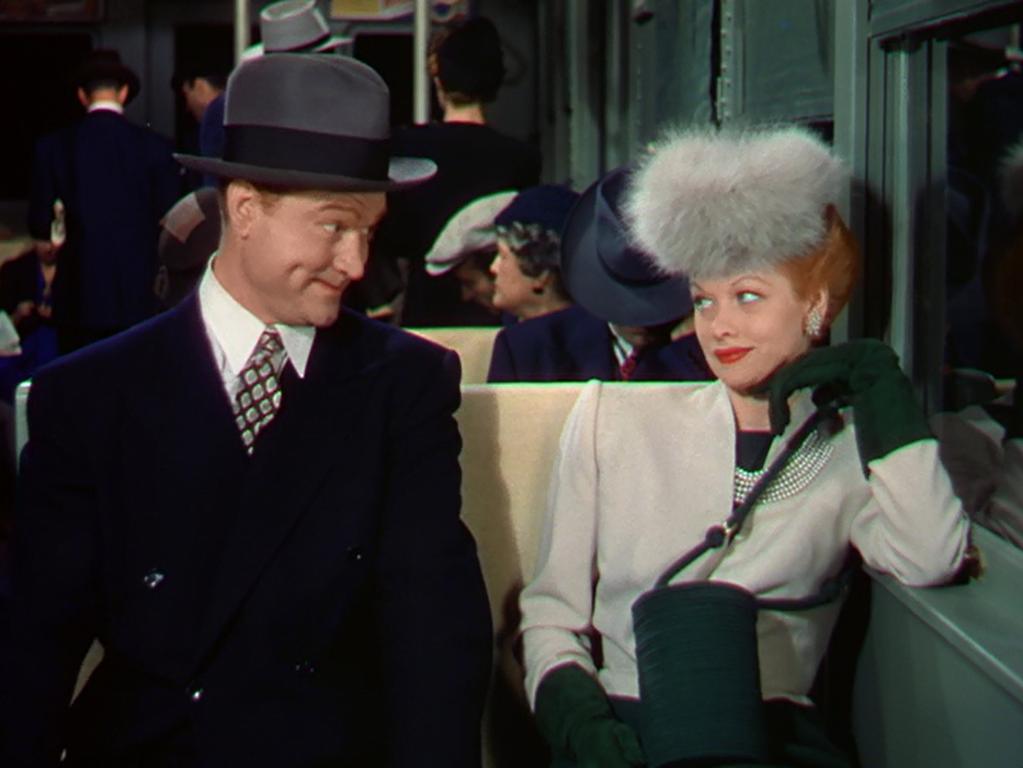
Lucy Before Lucy: Du Barry Was a Lady


In 1768, a young woman named Jeanne Bécu hatched a plan to cement her status in the world. Born the illegitimate daughter of a seamstress and unknown father, Jeanne was determined to improve her standings by becoming the official courtesan of King Louis XV of France. But in order to obtain that position, Jeanne needed a noble title. She got one by arranging a quickie marriage and falsifying key documents to imply she had some totally fake and very impressive ancestry. That’s how she became Madame du Barry, and it was only the beginning of her scandal-filled and tragic entry in the history books.

In 1939, Cole Porter thought the du Barry/Louis coupling would make a good backdrop for a sexy musical. (In his defense, he kind of thought anything would make a good backdrop for a sexy musical, it was his genius and his curse.) Broadway audiences saw the first production mounted with Ethel Merman, Bert Lahr and Betty Grable in the lead roles. The songs were raunchy and the jokes were raunchier, but it didn’t sit well with the tastemakers, and one New York Times critic wrote:

“The authors have struck a dead level of Broadway obscenity that doesn’t yield much mirth.”


I’m pretty sure that means there was too much innuendo and not enough story to back it up. Raves for the performances were the only positives to be found in the bleak petrified forest of newspaper reviews.

Which brings us to glamorous 1943, when Hollywood decided to make a version of Du Barry Was a Lady without Merman, Grable or Lahr – the things people actually liked about the show. Good idea, Hollywood.

MGM was interested in the film as a vehicle for Ann Sothern, so they bought the rights for her and started making promotional materials with her face on them. Sothern had become an unexpected sensation in 1939’s Maisie, where she played an adorably candid Brooklyn showgirl and wound up with her own film franchise and radio program. What MGM didn’t count on was that Sothern didn’t want to do the picture. (Some sources claim it was because she was pregnant with her daughter at the time, but that’s unverified and a little fishy given how the dates line up.)

It was such an unexpected surprise, the cartoon version of Sothern can still be seen in the title cards of the finished film:


Enter Lucille Ball, Sothern’s good friend and an actress transitioning between studios. It was decided that this was to be Lucy’s first outing at MGM after they'd bought her RKO contract.  Lucy would play May Daly and Madame du Barry in a dual role that revolved around a dream sequence. There would be towering wigs, dripping pearls, giant skirts, and songs. Lots of songs.

Lucy, as anybody who's seen Mame will tell you, couldn't really sing. This was handled by having Martha Mears dub her on most of her songs, except the finale number "Friendship." Occasionally, you can hear normally dubbed actors' own voices on what were considered "character songs" or songs that were supposed to be more humorous than pretty.

("Friendship" later found its way into the I Love Lucy canon when Lucy and Ethel perform it in "Lucy and Ethel Buy the Same Dress" from season three.)

For her Technicolor debut, hairstylist Sydney Guilaroff had an idea about Lucy’s coiffure. Several years before, Lucy had started colouring her blonde hair a subtle red-gold in order to stand out among the crowd of RKO stock beauties. Guilaroff wanted to take this to the next level, and dyed it an intense shade called “Tango Red.” He then swept the whole thing into a coiled up-do and hair sprayed the hell out of it. In Lucy’s autobiography, she claims she had to crack the lacquer with the brush at night, like busting open an eggshell.


Later on, during another film for MGM called Without Love, Lucy would work with hairstylist Irma Kusley (also Katherine Hepburn’s go-to favourite for movie star hair). It was Kusley who'd stick with Lucy through all the television shows and shades of dye to come. And though Guilaroff is generally credited with creating the Lucy look, Kursely was the one who honed it into what we remember.

Meanwhile, another red-haired comedian was making waves at the studio.

Red Skelton had impressed MGM in 1940 with a screen test that included his best routines. “Doughnut Dunkers,” in which he did an array of impressions of how different people dunked their doughnuts; “Guzzler’s Gin,” which was later adapted for a small segment in 1946’s Ziegfeld Follies, as well as the inspiration for Lucy’s own Vitameatavegamin bit; and “Impressions of Movie Heroes Dying,” which was pretty much exactly what you’re thinking.

They didn’t quite know what to do with him, though, and it wasn’t until he stole every scene in 1941’s Whistling in the Dark and made hits of its sequels, Whistling in Dixie and Whistling in Brooklyn, that they decided he was worth investing in. 


In 1942, he starred in a splashy musical with Ann Sothern called Panama Hattie. The chemistry had worked, so MGM thought Skelton would make a good fit for the role of the hatcheck boy who wins the Irish sweepstakes, accidentally drugs himself, and dreams he’s Louis XV. (This was all arranged before the Sothern/Ball switch.)

The script for Du Barry Was a Lady was undergoing major reconstructive surgery while the studio was putting together its cast. A lot of the naughtier jokes were jettisoned, along with several of the Cole Porter songs which would be replaced by studio-written alternatives that better fit the clean comedy stars MGM was trying to create. The role originated by Bert Lahr had just about everything changed as it was stretched like a piece of taffy to suit Skelton’s comedic style.

Roles were dropped, merged, or morphed, character’s names were changed for no obvious reason.
Like Gene Kelly’s character, who in the play was named Alex, is now named Alec. On top of which, he’s no longer trapped in a loveless marriage without the money for divorce, and in the dream sequence he’s the dashing and mysterious Black Arrow. And while nobody really minds watching Gene Kelly swash some buckles, it does make his sections of the film strangely earnest compared to the others.

The story ended up so that Skelton's character was in love with the lead showgirl at the nightclub where he worked. When he wins the Irish sweepstakes, he decides that he finally has enough money to sweep her off her feet, but she's already in love with Gene Kelly because she's a heterosexual woman and he's Gene Kelly. Come on. No way Red Skelton can win that fight.


Still, Red's got a zany idea that involves dosing his rival with a roofie. Only he ends up drinking it himself and dreaming he's the king of France, Lucy is his mistress, and Kelly is a dashing revolutionary sworn to kill him. (He can kill as many kings as he wants as long as he keeps saying words with his voice...)

In the end, the movie suffered from the same overall complaint that the play did. While all the lead performers are terrific, the story itself is strangely without charm. But, unlike the play, the film has all the grandeur of an MGM spectacle to cover its weaknesses.

The whole thing comes across like a sugary confection of bright costumes, vaudevillian song and dance numbers, and some unexpected delights. Tommy Dorsey’s orchestra performing in powdered wigs, and brief appearances by both Lana Turner and Ava Gardner are small highlights, with the first film appearance of Zero Mostel being a big one. Mostel plays Gene Kelly's best pal, a smarmy fortune teller who steals most of the early scenes.

For Lucy fans, it’s an interesting halfway point between the glamour girl phase and the start of her career as a comedienne. And, as Lucy herself later said, if nothing else it was a wonderful thing for her to work with Red Skelton.


Sunday, 26 June 2016

Mermaid Movie Mayhem!


Shark Week 2016 begins today, and that means my whole life is the ocean now. It's tradition. But if you're not a documentary fan, or sharks are too hardcore for you, consider celebrating the start of the pool party season with a mermaid film festival.

Here are my top picks, just to get you started:

Miranda (1948)


Glynis Johns stars as the delightfully naughty mermaid at the heart of this British film based on a play by Peter Blackmore. Bored with life in her pearl-filled grotto, Miranda strikes up an affair with a London doctor and follows him home. He disguises her as a patient in need of a wheelchair, and she soon sets about enchanting just about every man she meets, including a chauffeur played by David Tomlison – who would later team up with Johns again in Disney’s Mary Poppins.

Though Johns is pitch-perfect, the real delight comes from Margaret Rutherford as the nurse hired on to care for her. It’s frothy, fun, and a little dated in places, but for easy swimming, it’s tough to top.

The Mermaid (1965)


Despite the title, this one has the least conventional mermaid on the list. A Hong Kong Huangmei opera film directed by Kao Li, the more literal translation of its title is Fish Beauty.

When a carp spirit notices the loneliness of a jilted scholar, she takes on the form of his ex-lover and meets him in the garden one night. The scholar quickly falls in love with her, but believes the carp to be his beloved. The mix-up leads him to his former flame's house and a humiliating encounter with her. Things get pretty intense soon after, with talk of executions and forsaking immortality.

The same story was adapted as a television series in 2013 called The Legend of Chasing Fish.

Mr. Peabody and the Mermaid (1948)


A popular year for mermaids, 1948 also saw William Powell and Ann Byth dip into the legend. Based on a 1945 novel called Peabody’s Mermaid, Powell plays Arthur Peabody, a man whose midlife crisis gets a little more complicated when he reels in Lenore, a mute mermaid with a knack for making trouble.

The last of the great fantasy screwball comedies, poor Mr. Peabody seems to have the stars lined against him, and things don’t get any easier when his wife starts thinking he’s keeping giant fish in the hotel bathtub and having an affair. Things get worse when the police decide he’s a murderer. None of it's true of course, it's just fishtail mischief in a Caribbean setting.

Local Hero (1983)


The mermaid in this movie is actually part of a subplot, but with the whole thing being an underrated gem, I figured I’d include it and get more people talking about it. Burt Lancaster plays the eccentric owner of Knox Oil and Gas Company, a man in tune with the heavens.

Knox sends an American executive named MacIntyre to a small town in Scotland called Furness. Mac has instructions to buy the town to make way for a refinery, but soon comes up against an old man named Ben, who refuses to sell.

The Scottish Knox rep is played by a young Peter Capaldi, and this is where the mermaid angle comes in. The whole story has a gentle, fantastical tilt to it that pairs well with the flinty 80’s executive ethos. Well worth hunting down.

Splash (1984)


Tom Hanks and Darryl Hannah star in this beloved classic, with Hanks playing a man who writes off his childhood mermaid encounter as a near-death hallucination. Madison, the mermaid who saved his life when they were kids, decides it’s time to hunt down her first love and get a good look at New York City while she’s at it.

Full of memorable moments like learning English from a wall of department store televisions, and with a supporting character played by John Candy, this is the jewel in the summery rom-com crown... or the highest prong on its trident, maybe? 

Honorary Mentions: 

Peter Pan (1953) Used for the image at the top, it contains the best mermaids-will-be-mermaids legal defense of all time: "But we were only trying to drown her!"

Million Dollar Mermaid (1952) Or anything else with Esther Williams in it.

Beach Blanket Bingo (1965) That's the one where Bonehead falls in love with a mermaid named Lorelei while everyone else tries to stop South Dakota Slim from killing Linda Evans with a buzz saw. I'd like to say that some of that was over-simplified for comedic effect, but nope! It's insane!


Tuesday, 7 June 2016

Lux Radio Theater: Mayerling


With all of last week's talk of royalty and Cecil B. DeMille, I thought it was fitting to try to track down the Lux Radio Theater broadcast of Mayerling. It features William Powell as Prince Rudolf of Austria, a role originated by Charles Boyer in a 1936 French film of the same name. Though the original Mayerling had been an international success, it wasn't until 1938's Algiers that Boyer became well-known to American audiences.

Full disclosure: I haven't seen the film, so I don't know how faithfully this adapts it. What I do know is that though an American remake was in the works for many years, it didn't actually happen until 1968, when MGM decided it was a good fit for the tragically romantic Omar Sharif. In between, there was a French remake called Le Secret de Mayerling and a 1957 episode of Producer's Showcase featuring Mel Ferrer as Prince Rudolf and Audrey Hepburn as Mary Vetsera. The episode was later distributed in Europe as a feature film.

As C.B. tells us in the introduction to the play, all versions of Mayerling are based on a real event, the murder-suicide committed by Rudolf at his hunting lodge, taking the life of his young mistress. It was Rudolf's death that set in motion the events leading to the first World War. And, as you might suspect listening to the program, the true story is much more sordid than its romanticized counterpart.


****

Upcoming Events:

I'll be participating in In The Good Old Days of Classic Hollywood's Joan Crawford Blogathon. It looks like it's going to be one a terrific opportunity to learn about a complicated woman and honour her contributions as an actress, so if you're at all interested in Joan Crawford, mark it on your calendar. And if you have a blog, sign up!

I've also been invited to join the Darlin' Dallasers Blogathon, which aims to highlight the work of Dallas favourites and guest stars in non-Dallas productions. There are already some great topics on the roster (including Son of the Blob directed by Larry Hagman), and I'll be highlighting Patrick Duffy's performance in a made-for-television movie about psychic ghosts. I'm so excited!


Thursday, 2 June 2016

Cleopatra (1934)


Claudette Colbert was tired of being a sex symbol.

It all started in 1932 with The Sign of the Cross, an elaborate spectacle that director Cecil B. DeMille had managed to put together on a shoestring budget. The film is almost comically lurid, and between the scantily clad women being fed to crocodiles and the “Dance of the Naked Moon” it’s not exactly the standard Christian Epic. It made money, though, and Colbert’s part had been pretty good.

She played Empress Poppea, the beautiful second wife of Nero. The best of her scenes take place in a milk bath – “real asses’ milk” according to DeMille at a press conference, but in actuality just regular old powdered cows’ milk. The lights kept heating it up, so it soured quickly and smelled terrible; nevertheless, Colbert powered through her discomfort and delivered a memorable and intriguing performance.

That didn’t matter at all, though, because everybody was talking about her boobs. You could see ‘em when she was in the tub!


Even the Catholic Church was talking about Claudette Colbert’s popcorn catchers, and cited them as a reason they were forming the Catholic Legion of Decency to combat objectionable media. True fact.

It was understandable, then, that when 1934 rolled around and she was asked by DeMille to play Cleopatra she was hesitant. For the most part, history had painted Cleopatra as a seductress who used her perfumed wiles to get powerful men into bed with her.

The Romans had won the war, with her rival Octavian left standing to be in charge of the telling of the tale, and it was his version that trickled down to Shakespeare – responsible, for the most part, for the inaccurate elements that have become best known – and through Shakespeare into lavish Victorian paintings. But the Egyptology craze that had begun in the 1920’s was changing what the average non-Egyptian knew about pharaohs, and it soon became apparent that there was more to Cleopatra than a pair of soft lips whispering into the ears of powerful men.

Despite having appendicitis, Claudette Colbert agreed to do the picture.

(Remember all of this when you hear old stories about her being a difficult actress. She showed up to work a twelve hour day in a stinking pool of milk, did her next film with an exploding organ in her body, and was literally always on time with her lines learned, starring in three of 1934’s biggest money makers and critical successes. Then she wanted to take a vacation and asked for a raise, and boom. Difficult.)


With Warren William and his Barrymore-reminiscent profile joining as Julius Caesar, and newcomer Henry Wilcoxon set to play Marc Antony, things work out pretty good on the casting front. William was the king of the Pre-Code era, and like Caesar he would find himself becoming controversial as a new empire rose from the stones he had helped set. In his case, it would be a Hollywood changed by censorship and uncertain how to handle the mix of heroism and ethical dubiousness of his usual characters. By his early death in 1948, he was already a faded star.

Wilcoxon, on the other hand, would continue a long and fruitful career with DeMille, eventually producing with him on The Greatest Show on Earth, The Buccaneer, and The Ten Commandments. Like Antony, the death of his lauded mentor meant hard times for him, and his career struggled after 1959.

Both male leads acquit themselves well in Cleopatra, with the more experienced William turning in some unexpectedly boyish humour and gliding over the clunky, unnatural dialogue with ease. Wilcoxon is a sturdy figure, rough and unpolished in looks and mannerisms, and it suits his character, even if he doesn’t give the most convincing speeches.


Early DeMille films all have terrible, terrible, terrible dialogue, btw. It’s just how it goes. (Right at the beginning, an Egyptian asks a pushy Roman soldier: “What do you think you own, the earth?” The Roman soldier replies: “Yes!” It’s supposed to be insight into Roman arrogance. It’s super subtle.)

As a director, he was more concerned with what characters were doing rather than saying, and where they were doing things, what they were wearing while they did them, and how many extras could be in the shot watching. It was about spectacle. In the ‘30s – kind of like now – when people went to the trouble of paying for a movie ticket, they wanted to see something.

And, if nothing else, Cleopatra is certainly worth looking at.

The sets are dynamite. Art deco infused Ancient Egypt, gilded with gold and dwarfing the human figures with its grandeur. Highly stylized and completely historically inaccurate, the sets bring to life a concept missing in so many other films about pharaohs: that Egypt was bigger than those that ruled it. It was an ancient place even in the time of Cleopatra. She lived closer to man landing on the moon than she did to the year the pyramids were constructed, and she was doomed to be the last link in a chain that was being shattered by a Roman civil war. Early on, Cleopatra’s face is framed with an enormous sunken statue’s, the monument to the pharaoh of old slowly sinking into the sand as she begins, unknowingly, her quest to stop her empire’s demise.


Rome is full of airy gardens, and unexpected corridors. The sequence when Caesar parades through the streets is intriguingly claustrophobic, with its square buildings and narrow streets. As though Rome is an anthill, full of very dangerous ants.

Hans Dreier did the art direction. He’d later win an Academy Award for Sunset Boulevard.

The legendary Travis Banton did the costumes. The Romans are strutting peacocks, swathed in dramatic dark velvets, and shimmering silks. Octavian, especially, looks dandified and ornamental in his white enamel breastplate, and his first outfit that looks like something you’d be more likely to see on a Star Trek pleasure planet than in Egypt. Julius Caesar, as his position becomes more vulnerable unbeknownst to him, makes a shift from heavy fabrics and dark colours, to light white tunics.


It’s the women who stand out the most, though. Cleopatra herself is ornamented in winged crowns, golden cobras, scarab amulets, jeweled collars, strands of pearls, and very little fabric. The dresses for all the female characters are extremely low-cut, and none cut lower than those of the pharaoh.

Even though she looks gorgeous, the skimpiness was not what Claudette Colbert had been expecting. And it added fuel to the Poppea-boobgate fire, stoking her image as a sex-symbol and shifting the focus away from her performance. The costuming was exactly the kind of thing she’d been hoping to avoid.


But what about the role itself? Is Cleopatra different here than in all the male-driven stories before that ignore her role as politician in favour of amping up the girlfriend-of-famous-Romans angle?

Yes and no.

Ultimately, the story shifts gears from being a historical drama to being a tragic romance, which creates a sluggish third act and an indecisive Cleopatra. To the story – and Colbert’s – credit, we see her transform from a surly, 18 year-old princess caught up in world politics to a cool, even-headed manipulator. At the heart of her motivation is Egypt. A massive inheritance, mired in symbolism and tradition, that she loves above all other things.

Until Antony comes along, and reverses her seduction so successfully that she would hand Egypt over to its conquerors rather than risk his life.

Yikes.


Apart from having little bearing on what was actually going down during the Roman civil wars and the formation of the Roman Empire, it’s a blow to her characterization. Egypt is presented as the prize throughout, and when she tries to sign it away to Octavian, it’s an undignified and soppy moment for Cleopatra. (Albeit, it’s a sincere improvement over Theda Bera’s silent 1917 Cleopatra, who was a tyrannical sex-fiend with no sense of duty to her country.)

She becomes, unfortunately, defined by her romantic entanglements, rather than the nation she leads or the culture she’s desperately trying to preserve.

When all was said and done, Claudette Colbert managed to leverage the role into a new on-screen identity, though. It showed her what she didn’t want to be, and its box-office success and Oscar nominations, along with her other 1934 project, It Happened One Night, proved she was capable of carrying an impressive range of roles. She vowed that she would never, ever play the scantily clad seductress again, and she never did.

It was a big step forward in the story of Claudette Colbert, and a small step forward in how we tell the story of one of history’s most famous and misunderstood women.

But that’s not the last we’ll hear of Cleopatra this week! Tomorrow, we’ll be looking at the 1963 remake starring Elizabeth Taylor in some game-changing eyeliner.

And don’t forget to check out all the other fantastic entries in the Royalty on Film Blogathon!