Showing posts with label Lucy Before Lucy. Show all posts

Saturday, 9 July 2016

Lucy Before Lucy: Du Barry Was a Lady


In 1768, a young woman named Jeanne Bécu hatched a plan to cement her status in the world. Born the illegitimate daughter of a seamstress and unknown father, Jeanne was determined to improve her standings by becoming the official courtesan of King Louis XV of France. But in order to obtain that position, Jeanne needed a noble title. She got one by arranging a quickie marriage and falsifying key documents to imply she had some totally fake and very impressive ancestry. That’s how she became Madame du Barry, and it was only the beginning of her scandal-filled and tragic entry in the history books.

In 1939, Cole Porter thought the du Barry/Louis coupling would make a good backdrop for a sexy musical. (In his defense, he kind of thought anything would make a good backdrop for a sexy musical, it was his genius and his curse.) Broadway audiences saw the first production mounted with Ethel Merman, Bert Lahr and Betty Grable in the lead roles. The songs were raunchy and the jokes were raunchier, but it didn’t sit well with the tastemakers, and one New York Times critic wrote:

“The authors have struck a dead level of Broadway obscenity that doesn’t yield much mirth.”


I’m pretty sure that means there was too much innuendo and not enough story to back it up. Raves for the performances were the only positives to be found in the bleak petrified forest of newspaper reviews.

Which brings us to glamorous 1943, when Hollywood decided to make a version of Du Barry Was a Lady without Merman, Grable or Lahr – the things people actually liked about the show. Good idea, Hollywood.

MGM was interested in the film as a vehicle for Ann Sothern, so they bought the rights for her and started making promotional materials with her face on them. Sothern had become an unexpected sensation in 1939’s Maisie, where she played an adorably candid Brooklyn showgirl and wound up with her own film franchise and radio program. What MGM didn’t count on was that Sothern didn’t want to do the picture. (Some sources claim it was because she was pregnant with her daughter at the time, but that’s unverified and a little fishy given how the dates line up.)

It was such an unexpected surprise, the cartoon version of Sothern can still be seen in the title cards of the finished film:


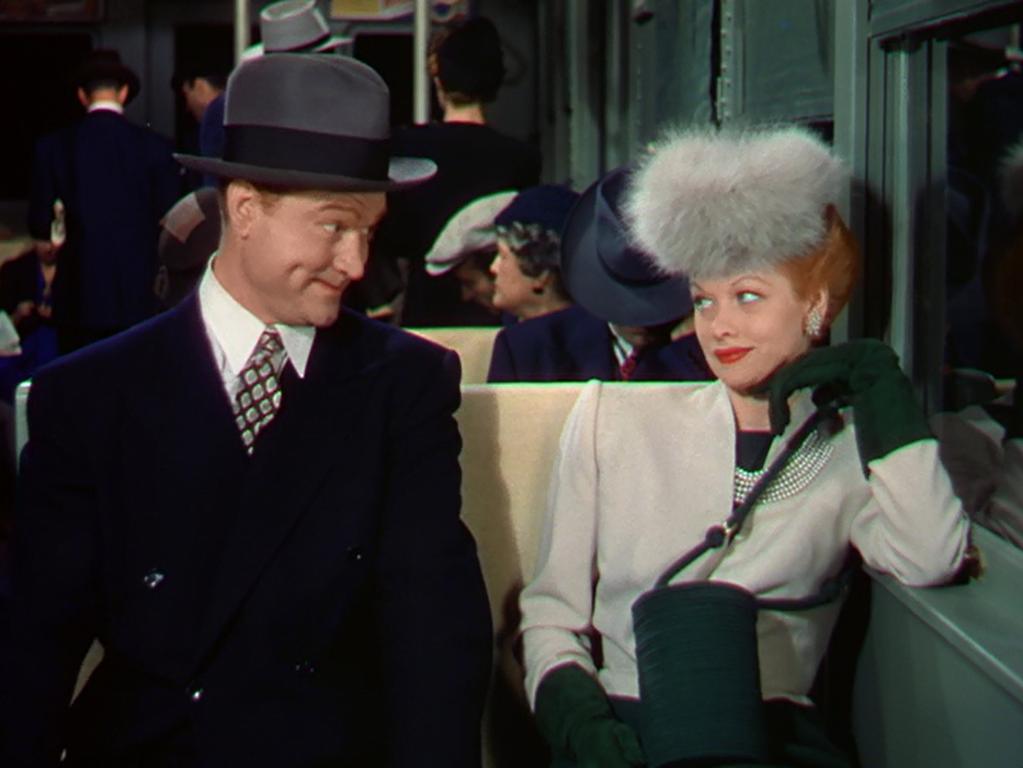
Enter Lucille Ball, Sothern’s good friend and an actress transitioning between studios. It was decided that this was to be Lucy’s first outing at MGM after they'd bought her RKO contract.  Lucy would play May Daly and Madame du Barry in a dual role that revolved around a dream sequence. There would be towering wigs, dripping pearls, giant skirts, and songs. Lots of songs.

Lucy, as anybody who's seen Mame will tell you, couldn't really sing. This was handled by having Martha Mears dub her on most of her songs, except the finale number "Friendship." Occasionally, you can hear normally dubbed actors' own voices on what were considered "character songs" or songs that were supposed to be more humorous than pretty.

("Friendship" later found its way into the I Love Lucy canon when Lucy and Ethel perform it in "Lucy and Ethel Buy the Same Dress" from season three.)

For her Technicolor debut, hairstylist Sydney Guilaroff had an idea about Lucy’s coiffure. Several years before, Lucy had started colouring her blonde hair a subtle red-gold in order to stand out among the crowd of RKO stock beauties. Guilaroff wanted to take this to the next level, and dyed it an intense shade called “Tango Red.” He then swept the whole thing into a coiled up-do and hair sprayed the hell out of it. In Lucy’s autobiography, she claims she had to crack the lacquer with the brush at night, like busting open an eggshell.


Later on, during another film for MGM called Without Love, Lucy would work with hairstylist Irma Kusley (also Katherine Hepburn’s go-to favourite for movie star hair). It was Kusley who'd stick with Lucy through all the television shows and shades of dye to come. And though Guilaroff is generally credited with creating the Lucy look, Kursely was the one who honed it into what we remember.

Meanwhile, another red-haired comedian was making waves at the studio.

Red Skelton had impressed MGM in 1940 with a screen test that included his best routines. “Doughnut Dunkers,” in which he did an array of impressions of how different people dunked their doughnuts; “Guzzler’s Gin,” which was later adapted for a small segment in 1946’s Ziegfeld Follies, as well as the inspiration for Lucy’s own Vitameatavegamin bit; and “Impressions of Movie Heroes Dying,” which was pretty much exactly what you’re thinking.

They didn’t quite know what to do with him, though, and it wasn’t until he stole every scene in 1941’s Whistling in the Dark and made hits of its sequels, Whistling in Dixie and Whistling in Brooklyn, that they decided he was worth investing in. 


In 1942, he starred in a splashy musical with Ann Sothern called Panama Hattie. The chemistry had worked, so MGM thought Skelton would make a good fit for the role of the hatcheck boy who wins the Irish sweepstakes, accidentally drugs himself, and dreams he’s Louis XV. (This was all arranged before the Sothern/Ball switch.)

The script for Du Barry Was a Lady was undergoing major reconstructive surgery while the studio was putting together its cast. A lot of the naughtier jokes were jettisoned, along with several of the Cole Porter songs which would be replaced by studio-written alternatives that better fit the clean comedy stars MGM was trying to create. The role originated by Bert Lahr had just about everything changed as it was stretched like a piece of taffy to suit Skelton’s comedic style.

Roles were dropped, merged, or morphed, character’s names were changed for no obvious reason.
Like Gene Kelly’s character, who in the play was named Alex, is now named Alec. On top of which, he’s no longer trapped in a loveless marriage without the money for divorce, and in the dream sequence he’s the dashing and mysterious Black Arrow. And while nobody really minds watching Gene Kelly swash some buckles, it does make his sections of the film strangely earnest compared to the others.

The story ended up so that Skelton's character was in love with the lead showgirl at the nightclub where he worked. When he wins the Irish sweepstakes, he decides that he finally has enough money to sweep her off her feet, but she's already in love with Gene Kelly because she's a heterosexual woman and he's Gene Kelly. Come on. No way Red Skelton can win that fight.


Still, Red's got a zany idea that involves dosing his rival with a roofie. Only he ends up drinking it himself and dreaming he's the king of France, Lucy is his mistress, and Kelly is a dashing revolutionary sworn to kill him. (He can kill as many kings as he wants as long as he keeps saying words with his voice...)

In the end, the movie suffered from the same overall complaint that the play did. While all the lead performers are terrific, the story itself is strangely without charm. But, unlike the play, the film has all the grandeur of an MGM spectacle to cover its weaknesses.

The whole thing comes across like a sugary confection of bright costumes, vaudevillian song and dance numbers, and some unexpected delights. Tommy Dorsey’s orchestra performing in powdered wigs, and brief appearances by both Lana Turner and Ava Gardner are small highlights, with the first film appearance of Zero Mostel being a big one. Mostel plays Gene Kelly's best pal, a smarmy fortune teller who steals most of the early scenes.

For Lucy fans, it’s an interesting halfway point between the glamour girl phase and the start of her career as a comedienne. And, as Lucy herself later said, if nothing else it was a wonderful thing for her to work with Red Skelton.

Saturday, 30 April 2016

Lucy Before Lucy: Room Service


In May of 1955, a tiny piece of television history happened when Lucille Ball and Harpo Marx did their famous mirror routine in “Lucy and Harpo Marx.” (Episode titles weren’t a big deal on I Love Lucy.) For those of you who haven’t seen it, I suggest watching it right this second and then coming back for the rest of this post. For those of you who can’t watch it for some reason, it goes like this:

Lucy and Ethel have convinced their friend Caroline that they hobnob with celebs 24/7 in glamorous California. Caroline decides to come meet one for herself, only the whole thing is a lie, so there are no celebrities available to come visit. Luckily, Caroline is blind as a bat without her glasses. The solution is obvious – well, obvious to Lucy, regular humans would probably do something different. Caroline will “lose” her glasses, and Lucy will impersonate various celebrities to amuse her and keep the lies alive. One of the celebrities she chooses is Harpo Marx, who Ricky and Fred have asked to come over, and Harpo arrives just as Lucy is pretending to be him. In order to keep the hopeless charade going, she mimics his every move, pretending to be his reflection.

But that classic moment wasn’t the first time Lucy and Harpo had worked together.

I have to confess to not knowing too much about the Marx Brothers. There are only so many hours in a day, and I watch a lot of things. (I should probably choose to watch something other than Abbott and Costello Meet Frankenstein the next time I’m sad, though. Spread my wings a little.) What I do know is that it was unusual for the Marx Brothers to play characters that hadn’t been specifically written for them, but after 1933’s Duck Soup, Zeppo Marx stopped performing and began managing the act. He found a Broadway play called Room Service, and negotiated with RKO to purchase it for the Marx Brothers’ next project. This was some fancy footwork on Zeppo’s part because, at the time, the Brothers were under contract with MGM to make a picture a year.

The play was written by Allen Boretz and John Murray, and according to reliable sources like Wikipedia and IMDB, it’s a pretty faithful adaptation. Also, one time, Jack Lemmon was in a 1953 revival and played the Groucho role. The things you can learn when you’re double checking release dates…

Lucy, somewhat disappointingly, has a straight role in the film. She plays the leading lady of Groucho’s new Broadway play, which may or may not exist, and she brings an eager young playwright to the hotel that Groucho lives and works out of to invest. Zaniness ensues.


But not quite as much zaniness as previous Marx Brothers outings. The larger-than-life, absurdist personalities that audiences had grown to love didn’t work for the pipe laying necessary in a more mainstream and subdued comedy, even if that comedy happened to be a hotel farce. It’s not a very potent mix, and with history’s hindsight, Lucy feels squandered in a thankless role.

Also, there’s a distinct note of ickiness going on by way of Ann Miller. When Ann Miller was 13 years old – 13 – she told the people hiring showgirls at the Black Cat Club in San Francisco that she was 18, and totally cool to work there, so they hired her because it was the 1930’s and nobody had time to double check things, a war was looming. A year or so later, she was discovered by Lucille Ball and RKO talent scout Benny Rubin, who she also told she was 18, and then she got a contract at RKO who also believed her to be not 14 years old at this point.

In this movie, which she made at age 15, we all get to watch her make out with her 30 year old love interest played by Frank Albertson, who probably didn’t know how old Ann Miller actually was because good god, Ann Miller, that was not okay! There are reasons for these age gates in society!

(It’s like Sullivan’s Travels. I don’t enjoy it, I just shake my head at Veronica Lake and wonder where the hell her parents were.)

Room Service is a disappointment for a few reasons, but it’s not the worst Marx Brothers movie. I’m told that one is called Go West. Still, it’s worth it to see Lucy forging the relationships with the male comics of the era before TV, creating a thread that would allow them all to last longer than they would’ve otherwise.

Lucille Ball was known for her work ethic and professionalism, even if she was a sometimes difficult personality because of a notorious lack of tact. But she was dogged in rehearsals, on time, and deeply committed to her material. 17 years after Room Service, this reputation brought Harpo Marx back to the studio at age 72, while he was recovering from a heart attack, and he and Lucy put smiles on countless people then and now, and for who knows how many generations to come.


So if you hear somebody complaining that Room Service isn’t as good as Duck Soup, tell them that it doesn’t have to be, because it brought Lucy and Harpo together. Then dump a milkshake down their pants or something.


Monday, 28 March 2016

Lucy Before Lucy: The Dark Corner


In most people’s minds Lucille Ball and film noir don’t occupy the same space. But, in 1946, Lucy co-starred in a neat little thriller called The Dark Corner.

At this time, she was 35 years old and making her B-movie circuit, starring in pretty much any genre that would have her. It was a strange time in her career, since she’d just aged out of the pin-up girl personae she’d had at RKO. You can’t be sexy and 35, that’s ridiculous. Everyone knows that when a woman hits the big 3-0, her faces just dissolves like Walter Donovan’s at the end of Indiana Jones and the Last Crusade.

Noir suits her, surprisingly – and then not so surprisingly at all, because she’s the enterprising career girl here and not a femme fatale or a moonlit gardenia like Veronica Lake.

She plays Kathleen Stewart, loyal secretary of private eye Bradford Galt.

Apart from having the kind of name you might give to punish an unwanted child, Bradford Galt has got some problems. He recently relocated his business to New York, trying to escape the Faustian bargain he made with his friend and lawyer Tony Jardine. The end result of that bargain was some jail time for Galt, and some lifelong anxieties for Jardine.

Galt’s pretty sure all of that’s behind him, though, and he’s eager for a fresh start. That’s why it’s such a bummer when he’s almost bumped off by a hired goon. But, naturally, it’s not as simple as he first thinks.

There’s a lot we’ve seen before from earlier noir offerings. The opening music is the exact theme heard in 1941’s I Wake Up Screaming; a takeoff on “Rhapsody in Blue” that sounds undeniably like a cityscape full of sad, busy people. Lucy’s character has more than a few echoes of Ella Raines in 1944’s Phantom Lady, another steadfast secretary who sticks by her boss through thick and thicker. And rounding out the villain’s team is Clifton Webb as Hardy Cathcart, a more complicated but less interesting version of the character he played in 1944’s Laura.

For me, Lucy carries the human elements of the tangled Chandler-inspired plot, and she carries them well. Kathleen seems lonely. Deeply lonely. It’s been a few layers of snappy dialogue and plucky gal Friday stick-to-it-iveness, but it’s there. And it’s Lucy who puts it there, saving you from spending too much time wondering just why she’d be so loyal to a man she’s had two dates with and calls “Mr. Galt.”

She made two other noirs, by the by, Two Smart People, also in 1946, and Lured in 1947. Two Smart People is about a conman love triangle, while Lured is a more precariously categorized film about Jack the Ripper copycat murders. Both are worth watching, but fall a little short of The Dark Corner.
And the reason for that is thanks to cinematographer Joe MacDonald. MacDonald was no stranger to the genre, and while the plot doesn’t measure up to the other entries on his resume, this is probably his best work.


So if you’re in the mood for something a little off the beaten path, both in the noir category and for a Lucy fan, check out The Dark Corner sometime. It’s a fine way to kill a Saturday afternoon.

Tuesday, 23 February 2016

Lucy Before Lucy: My Favorite Husband


CBS Radio was trying to ignore the fact that it was dying. Television was a crazy fad that nobody cared about because it was too expensive to buy one, and all the programs were hyper-intellectual “New York plays” broadcast live. Radio, on the other hand, was a cultural institution. In 1948, there wasn’t a person in America who didn’t have fond memories of one radio program or another. Jack Benny was probably the most famous entertainer in the country, and Jack Benny was 100% radio – until he got a TV show.

Radio needed something. Anything.

Back in 1942, Ray Milland and Betty Field had starred in Are Husbands Necessary? a light comedy based on a series of novels by Isabel Scott Rorick. It concerned George and Mary Elizabeth Cugat, a happily married couple whose ship was generally steered by the “zany” Mary Elizabeth. Then, in 1943, the film was adapted for radio as an episode of Lux Radio Theater starring George Burns and Gracie Allen.

By 1948, it was decided that CBS would try the concept as a weekly series, with Ozzie and Harriet writers Frank Fox and Bill Davenport creating stories about affluent banker George’s daily struggles with his eccentric socialite wife, Liz. The audition episode (they didn’t call them pilots until TV) starred George Bowman – who would later run media training for the Nixon administration – and a B-movie redhead who’d been showing a surprising knack for comedy.

Lucille Ball.

Lucy was just about the only thing destined to stick with the radio version of the show. Bowman dropped out after that first episode, and was replaced by Richard Denning. Ten episodes in, it was obvious that the wealth of the central couple was making it difficult for the audience to relate to them, and (frankly) the jokes weren’t funny enough. CBS shuffled some things around and moved a young writing duo by the names of Madelyn Pugh and Bob Carroll, Jr. onto My Favorite Husband to make some changes.

The Cugats became the Coopers, to avoid confusion with popular bandleader Xavier Cugat. They were now middle class suburbanites, whose best friends were a blustering couple called Rudolph and Iris Atterbury, and who lived next door to the Wood family. The Woods had eleven children, and the patriarch of the wild clan was a scene-stealing Hans Conried. Also thrown into the mix was Eleanor Audley as George’s aristocratic and impossible-to-please mother.

Under Pugh and Carroll, it became obvious that making the audience react to Liz was driving the show much more powerfully than having the audience sit through George’s reactions to Liz. So Lucy stepped forward, and Richard Denning didn’t have a problem with it. Denning was a nuts-and-bolts actor, he has a surprisingly large filmography of characters that hold up fictional worlds so that the stars can play in them. That was his strength, and Lucy’s strength was being the hurricane of a story. By the time she became a TV legend, that was obvious, but back in her radio days, everyone was discovering just how funny she could be.


The changes were brilliant. The reviews were glowing. And, most importantly, people were tuning in to listen.

In the ghost town days of radio, when there were no more hits, CBS had a major show on its hands.
Not too long before all of this, CBS had negotiated contracts with NBC’s top radio stars to bring them over to CBS television. The big one was the aforementioned Jack Benny, and there is no way to overstate what a huge deal Jack Benny was at this time. Courting him had cost literally all the Christmas bonuses at CBS. Nobody got Christmas bonuses, and nobody was mad because they knew that if they worked at the network with a star as big as that, it would be a hell of a lot cushier than working at the network that had to put something in the competing time slot. CBS was betting their future on television, and it was going extremely well.

So, no big surprise, they wanted to move My Favourite Husband to TV. By now, it was obvious that you couldn’t do that without Lucille Ball, and Lucille Ball wanted a change made. Instead of Richard Denning, she wanted her husband to be played by her real-life husband Desi Arnaz. It wasn’t because she had anything against Denning, she just saw the opportunity for Desi. (According to Denning, Lucy told him later that she thought giving Desi the part “would help her marriage.”)

Of course, CBS couldn’t really see Desi Arnaz and his Cuban accent as a manager in a mid-west bank, living in typical suburbia. But Lucy would not budge, and Denning had already altered his schedule. The Coopers were recast with Joan Caulfield and Barry Nelson, and they went back to the “rich people doing zany things in high society” format… which you might remember as “the format that didn’t really work.”

Unsurprisingly, the show didn’t last long, and that was the end of the Cooper-nee-Cugats.

But! Madelyn Pugh and Bob Carroll Jr. hadn’t been attached to the TV transfer, and they’d been mulling over how to get Lucy on TV, and how to make the audience “believe” Desi Arnaz. What if they were a couple who worked in entertainment? And Desi was a band leader? And they lived in a place with so many immigrants, you’d never have to tell a story about the husband being an immigrant?

They pitched the new concept as I Love Lucy.

It went pretty well.


Want to listen to My Favorite Husband? Check it out here.